One day I must definitely take this theme to therapy: why am I so obsessed with war movies? I have no idea when it started or which was the first movie that deeply marked me. But one of them is definitely “La Vita è Bella”, the Italian classic about a father who tries to show the humorous side of life to his son while they are taken to a Jew concentration camp. I clearly remember we had the DVD file of this movie at home, and my father would always relate to it as one of the most beautiful movies he had ever seen, and probably the one that has got him most emotional ever. But how could a war movie evoke that?
Perhaps hearing this description about such a strange topic to me – war- was something that I somehow kept in mind. Back then, I used to look at La Vitta è Bella’s DVD cover with a mix of fear and curiosity, being that probably when I started to picture the solemn, scary and curious imagery of war movies in my child’s mind. And after that I don’t remember much – only that year after year I’ve been watching all sorts of movies about wars. And learning and feeding my curiosity through it. I would read about the great wars in school and then try to depict any hidden stories, informations and curiosities about them.
Looking back now, I might have a hint on why this topic has always intrigued me so much. Wars aren’t something relatable in my country as it is here in Europe (and recently-separated Britain). Of course we did have civic battles within the country, but nothing as impactful as the great wars comes to mind in my country’s recent History. In WWII, for instance, Brazil had a small role in strategies, engaging mostly in aerial and naval operations in the South Atlantic, enabling the invasion of the North of Africa by the Allies. A garrison of Brazilian soldier’s were also sent to Italy to fight against the fascists, but that is all.
So yes, probably the curiosity for the “unknown” helps to explain why I’ve always liked to read, explore and specially watch movies about war. Living in Britain, now, is a full plate to explore it even more. When I first got here, the Imperial War Museum (IWM) got the on top of the must-see list in London. And so me and three friends went there – in the oddest context possible. We had just been to a wedding gown store, for the first trial of a wedding dress of one of them. On our way back home, the bus would stop near the museum and so we decided to visit.
From the outside one can already feel the energy of the place: two giant cannons are placed in front of the main doors, pointing to the street. It immediately evokes a “phallogocentrism”, as coined by French philosopher Jacques Dersida, so characteristic of wars. When entering the place, the high ceiling of the large central hall reinforced that feeling. Aircrafts were hanging from it, in a beautiful scenario that depicted the monumental aspect of wars. They are, indeed, bigger than all of us. They often involve hundreds of men and women who would have had a very different course of life if it wasn’t for them. Wars also have the power to unite people with absolutely different backgrounds and journeys towards a common goal. They often reveal a solidarity much hidden in our daily lives, as well as wide opening the doors of what is really essential in our lives.
We only had two hours before the museum’s closure, so we went straight to the temporary exhibition I wanted to see the most: Culture Under Attack. As defined in the briefing description this exhibition explored “how war threatens not just people’s lives, but also the things that help define us.”. It was divided into three parts: Rebel Sounds, Art in Exhile and What Remains. With a special remark to the third one. It hit me in a way I wasn’t prepared for – the best feeling to have when in a museum.
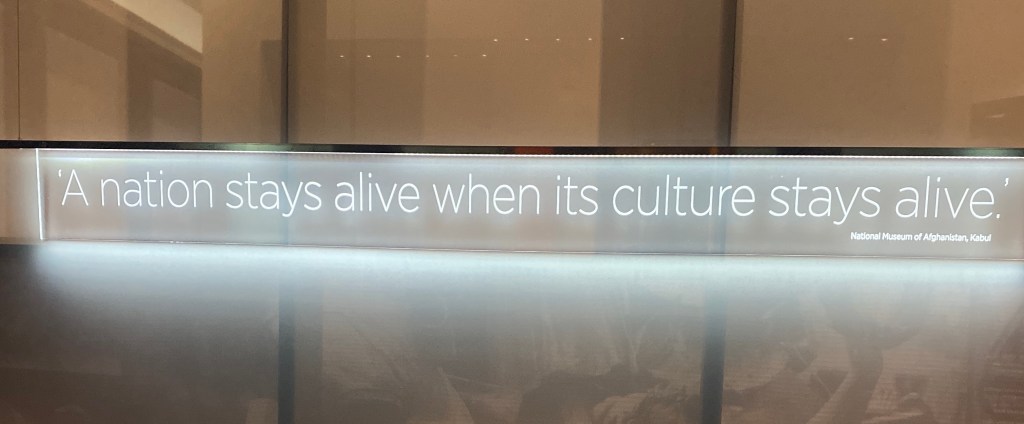
From the bombing of places to the Nazi theft of masterpieces of art, this section explored how culture is target in wars that might have wider effects than the objects and buildings themselves. If the murder of people is inevitable in war, destroying cultural heritage often strikes at the heart of entire communities. And in the end, if culture is the essence of a country, should it be preserved as thoroughly as life itself? How do we survive the destruction of our essence?
Many questions emerged from this (and I highly recommend watching the video available about the expo) and this is the merit of museums. Probably, of war itself. Although I have never been through one (and neither do I intend to) the hundreds of battles and attacks that humanity has provoked against itself had left us with more questions than certainties. In the end, the message behind it all might be to appreciate the little certainties we do have. Amongst chaos and fear, we can always find stories to remind us of that. La vita è bella!
 Postcards From The Other Side